


Updated Oct 11, 2025 Certification Exam OGEA-103 Dumps - Practice Test Questions
Updated Verified OGEA-103 dumps Q&As - Pass Guarantee or Full Refund
Part 2 of the exam builds upon the knowledge gained in Part 1, delving deeper into the TOGAF framework and addressing more advanced topics such as architecture governance, architecture content development, and the use of architecture models to support decision-making. It also covers the application of the TOGAF framework in real-world scenarios and provides practical guidance on how to use TOGAF to deliver successful architecture projects.
The OGEA-103 exam consists of two parts, Part 1 and Part 2. Part 1 is a multiple-choice exam that tests the candidates' knowledge of the TOGAF Standard, while Part 2 is a scenario-based exam that tests the candidates' ability to apply the TOGAF Standard in real-world situations. OGEA-103 exam is open book, meaning that candidates are allowed to use the TOGAF Standard during the exam. Passing the OGEA-103 exam is a valuable credential for enterprise architects, as it demonstrates their proficiency in the TOGAF Standard and their ability to create and manage enterprise architectures that align with the business goals of an organization.
NEW QUESTION # 17
What is an objective of the ADM Implementation Governance Phase?
- A. To establish the resources for architecture governance
- B. To ensure conformance for the target architecture
- C. To finalize the Implementation and Migration Plan
- D. To provide continual monitoring of the governance framework
Answer: B
Explanation:
The objective of the ADM Implementation Governance Phase is to provide an architectural oversight of the implementation and to ensure conformance for the target architecture. This phase involves establishing procedures and processes to monitor and control the implementation projects and to verify that they comply with the defined architecture. Reference: The TOGAF Standard | The Open Group Website, Section 3.2.7 Phase G: Implementation Governance.
NEW QUESTION # 18
Consider the following statement:
According to the TOGAF Standard a governed approach of a particular deliverable will ensure a system of continuous monitoring to check integrity changes decision-making and audit of all architecture-related activities Which deliverable is being referred to?
- A. The Statement of Architecture Work
- B. An Architecture Contract
- C. The Architecture Definition Document
- D. The Architecture Vision
Answer: B
Explanation:
An Architecture Contract is a deliverable that specifies the responsibilities and obligations of the parties involved in the implementation and governance of an architecture. It ensures a system of continuous monitoring to check integrity changes decision-making and audit of all architecture-related activities.
Reference: The TOGAF Standard | The Open Group Website, Section 3.3.4 Architecture Contracts.
NEW QUESTION # 19
Which of the following describes how the Enterprise Continuum is used when developing an enterprise architecture?
- A. To identify and understand business requirements
- B. To classify architecture and solution assets
- C. To coordinate with the other management frameworks in use
- D. To describe how an architecture addresses stakeholder concerns
Answer: B
Explanation:
The Enterprise Continuum consists of two complementary concepts: the Architecture Continuum and the Solutions Continuum1. The Architecture Continuum provides a consistent way to describe and understand the generic and reusable architecture building blocks, such as models, patterns, and standards, that can be applied and tailored to specific situations2. The Solutions Continuum provides a consistent way to describe and understand the specific and implemented solution building blocks, such as products, services, and components, that realize the architecture building blocks3. The Enterprise Continuum enables the reuse and integration of architecture and solution assets across different levels of abstraction, scope, and detail, ranging from foundation architectures to organization-specific architectures1.
The Enterprise Continuum is used when developing an enterprise architecture to support the following activities1:
*Selecting relevant architecture and solution assets from the Architecture Repository or other sources, based on the business drivers, goals, and requirements
*Adapting and customizing the architecture and solution assets to suit the specific needs and context of the enterprise
*Defining and developing the target architecture and the architecture roadmap, based on the gaps and opportunities identified between the baseline and the target states
*Defining and developing the implementation and migration plan, based on the architecture roadmap and the solution building blocks
*Governing and managing the architecture and solution assets throughout the architecture lifecycle, ensuring their quality, consistency, and compliance References: 1: The TOGAF Standard, Version 9.2 - Enterprise Continuum 2: The TOGAF Standard, Version
9.2 - Architecture Continuum 3: The TOGAF Standard, Version 9.2 - Solutions Continuum
NEW QUESTION # 20
Which section of the TOGAF template for Architecture Principles should highlight the business benefits of adhering to the principle?
- A. Statement
- B. Name
- C. Rationale
- D. Implications
Answer: C
Explanation:
According to the TOGAF Standard, 10th Edition, the rationale section of the architecture principles template should highlight the business benefits of adhering to the principle, as well as the business risks of not adhering to it 1. The rationale section should explain the reasoning behind the principle, and provide evidence or arguments to support it. The rationale section should also link the principle to the business drivers, goals, and objectives of the enterprise, and show how the principle contributes to the value and success of the enterprise.
The other options are not correct, as they have different purposes in the architecture principles template. The name section should provide a short and memorable name for the principle, such as "Information is an Asset" or "Business Continuity" 1. The statement section should provide a concise and formal statement of the principle, such as "The enterprise's information is recognized as a core asset, and is managed accordingly" or
"The enterprise's ability to provide critical services and products must be maintained in the event of a disaster" 1. The implications section should identify the impact of the principle on the enterprise, such as the changes, costs, benefits, and risks that may result from applying or violating the principle 1. References: 1:
TOGAF Standard, 10th Edition, Part III: ADM Guidelines and Techniques, Chapter 23: Architecture Principles, Section 23.3 Developing Architecture Principles.
NEW QUESTION # 21
Consider the following ADM phases objectives.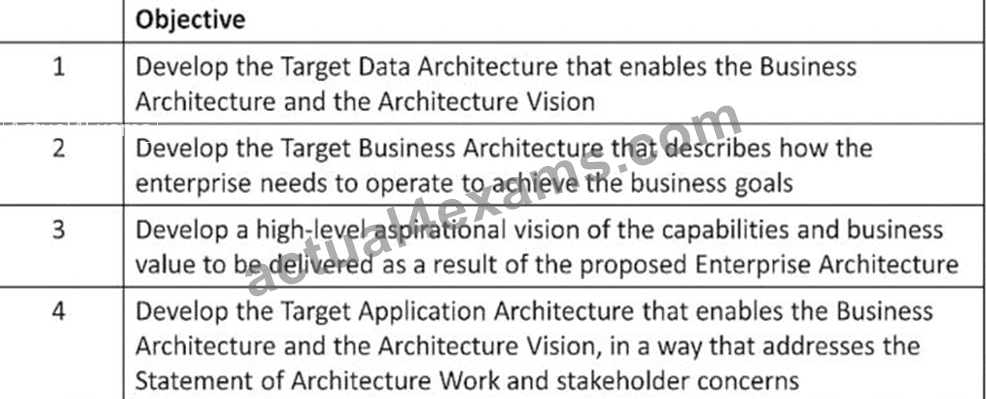
Which phase does each objective match?
- A. 1A-2B-3C-4D
- B. 1C-2D-3B-4A
- C. 1B-2D-3A-4C
- D. 1C-2B-3A-4C
Answer: D
Explanation:
Explanation
The objectives listed in the question correspond to the objectives of different phases of the TOGAF ADM (Architecture Development Method), which is a method for developing and managing an enterprise architecture1.
The ADM consists of nine phases, each with a specific purpose and output. The phases are1:
Preliminary Phase: To prepare and initiate the architecture development cycle, including defining the architecture framework, principles, and governance.
Phase A: Architecture Vision: To define the scope, vision, and stakeholders of the architecture initiative, and to obtain approval to proceed.
Phase B: Business Architecture: To describe the baseline and target business architecture, and to identify the gaps between them.
Phase C: Information Systems Architectures: To describe the baseline and target data and application architectures, and to identify the gaps between them.
Phase D: Technology Architecture: To describe the baseline and target technology architecture, and to identify the gaps between them.
Phase E: Opportunities and Solutions: To identify and evaluate the opportunities and solutions for implementing the target architecture, and to define the work packages and transition architectures.
Phase F: Migration Planning: To finalize the implementation and migration plan, and to ensure alignment with the enterprise portfolio and project management.
Phase G: Implementation Governance: To provide architecture oversight and guidance for the implementation projects, and to manage any architecture change requests.
Phase H: Architecture Change Management: To monitor the changes in the business and technology environment, and to assess the impact and performance of the architecture.
Based on the above definitions, we can match each objective with the corresponding phase as follows:
Objective 1: Develop the Target Data Architecture that enables the Business Architecture and the Architecture Vision. This objective is achieved in Phase C: Information Systems Architectures, where the data architecture is defined as a subset of the information systems architecture2.
Objective 2: Develop the Target Business Architecture that describes how the enterprise needs to operate to achieve the business goals. This objective is achieved in Phase B: Business Architecture, where the business architecture is defined as a subset of the enterprise architecture3.
Objective 3: Develop a high-level aspirational vision of the capabilities and business value to be delivered as a result of the proposed Enterprise Architecture. This objective is achieved in Phase A: Architecture Vision, where the architecture vision is defined as a high-level description of the target architecture and its benefits4.
Objective 4: Develop the Target Application Architecture that enables the Business Architecture and the Architecture Vision, in a way that addresses the Statement of Architecture Work and stakeholder concerns. This objective is achieved in Phase C: Information Systems Architectures, where the application architecture is defined as a subset of the information systems architecture2.
References:
1: The TOGAF Standard, Version 9.2, Chapter 5: Architecture Development Method (ADM)
2: The TOGAF Standard, Version 9.2, Chapter 9: Phase C: Information Systems Architectures
3: The TOGAF Standard, Version 9.2, Chapter 8: Phase B: Business Architecture
4: The TOGAF Standard, Version 9.2, Chapter 7: Phase A: Architecture Vision
NEW QUESTION # 22
Which of the following best describes the purpose of the Gap Analysis technique?
- A. To develop a set of general rules and guidelines for the architecture
- B. To identify items omitted from the Target Architecture
- C. To allocate resources for architecture projects
- D. To govern the architecture throughout its implementation process
Answer: B
NEW QUESTION # 23
What component of the Architecture Repository represents architecture requirements agreed with the Architecture Board?
- A. Governance Log
- B. Architecture Capability
- C. Architecture Requirements Repository
- D. Reference Library
Answer: C
Explanation:
Explanation
The Architecture Requirements Repository stores all the requirements that are output of the architecture development cycle, as well as the requirements that are input to the architecture development cycle1. The Architecture Requirements Repository includes the following types of requirements1:
*Stakeholder Requirements: These are the high-level requirements and expectations of the stakeholders, derived from the business drivers, goals, and objectives. They are captured and refined in the Architecture Vision phase and the Requirements Management phase.
*Architecture Requirements: These are the detailed requirements that specify what the architecture must do or deliver to meet the stakeholder requirements. They are derived and refined in the Business, Information Systems, and Technology Architecture phases.
*Implementation and Migration Requirements: These are the detailed requirements that specify what the implementation and migration projects must do or deliver to realize the architecture. They are derived and refined in the Opportunities and Solutions and Migration Planning phases.
The Architecture Requirements Repository is used to manage the architecture requirements throughout the architecture lifecycle, ensuring their traceability, consistency, and compliance1. The Architecture Board is the authority that reviews and approves the architecture requirements, as well as the architecture deliverables and artifacts, as part of the architecture governance process2.
References: 1: Architecture Requirements Repository 2: Architecture Board
NEW QUESTION # 24
In which part of the ADM cycle do building block gaps become associated with work packages that will address the gaps?
- A. Phases B C and D
- B. Phase E
- C. Phases F
- D. Phases G and H
Answer: B
Explanation:
In Phase E of the ADM cycle, building block gaps become associated with work packages that will address the gaps. This phase involves creating an Implementation and Migration Plan that defines a set of work packages and Transition Architectures that will deliver the Target Architecture. Reference: The TOGAF Standard | The Open Group Website, Section 3.2.5 Phase E: Opportunities & Solutions.
NEW QUESTION # 25
According to the TOGAF standard, what term describes an individual with an interest in a system?
- A. stakeholder
- B. consumer
- C. lead architect
- D. sponsor
Answer: A
Explanation:
According to the TOGAF Standard, 10th Edition, a stakeholder is "an individual with an interest in a system"
1. A stakeholder can be anyone who is affected by the system, or who can influence or be influenced by the system. Stakeholders can have different roles, perspectives, and concerns regarding the system, and they can be internal or external to the organization. Stakeholder management is a technique that helps to identify, analyze, and engage the stakeholders of an architecture project, and to address their needs and expectations 2.
The other options are not correct, as they are not the term used by the TOGAF Standard to describe an individual with an interest in a system. A consumer is "an individual or group that uses a product or service" 1.
A lead architect is "an individual who is responsible for leading the development of an architecture" 1. A sponsor is "an individual who provides funding and support for an architecture project" 1. References: 1:
TOGAF Standard, 10th Edition, Part I: Introduction, Chapter 3: Definitions. 2: TOGAF Standard, 10th Edition, Part III: ADM Guidelines and Techniques, Chapter 24: Stakeholder Management.
NEW QUESTION # 26
Consider the illustration.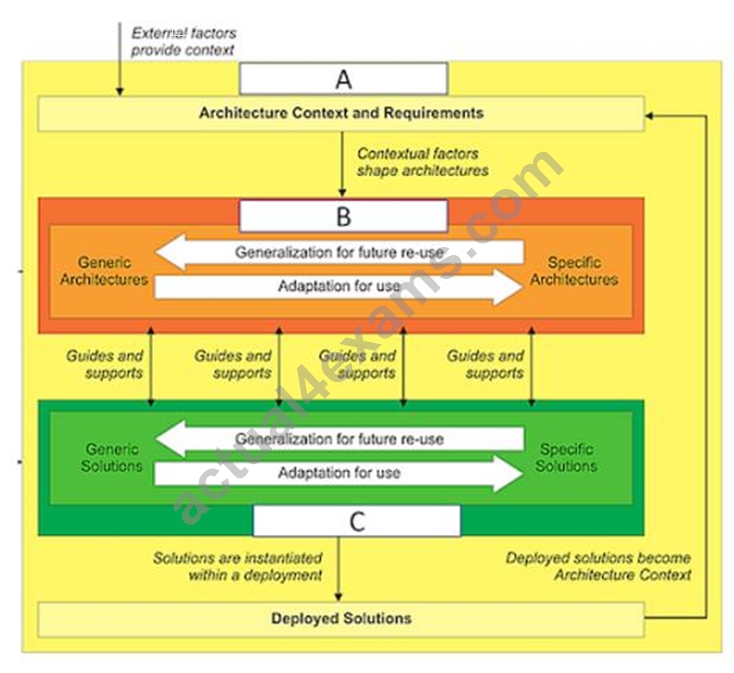
What are the items labelled A, B and C?
- A. A-Enterprise Continuum, B-Architecture Continuum, C-Solutions Continuum
- B. A-Enterprise Architecture, B-Architecture Building Blocks, C-Solutions Building Blocks
- C. A-Architecture Vision, B-Business Architecture, C-Information Systems Architecture
- D. A-Enterprise Strategic Architecture, B-Segment Architecture, C-Solutions Architecture
Answer: A
Explanation:
The illustration shows the relationship between the Enterprise Continuum, the Architecture Continuum, and the Solutions Continuum, which are key concepts in the TOGAF framework. The Enterprise Continuum is a view of the Architecture Repository that shows how generic foundation architectures can be leveraged and specialized to support the requirements of an individual organization. The Architecture Continuum specifies a structured classification for architectural artifacts, such as models, patterns, and descriptions, that can be reused and adapted across different domains and levels of abstraction. The Solutions Continuum identifies implemented solutions that support various stages of business and IT capability evolution, such as common systems, industry solutions, and organization-specific solutions. The illustration also shows how the architecture context and requirements are influenced by external factors, such as business drivers, stakeholders, and standards, and how they shape the generic and specific architectures and solutions. The illustration also shows how the deployed solutions become part of the architecture context for future iterations of the architecture development cycle. Reference:
* TOGAF Standard, 10th Edition, Part II: Architecture Development Method, Chapter 6: Architecture Repository, Section 6.2 Enterprise Continuum.
* TOGAF Standard, 10th Edition, Part IV: Architecture Content Framework, Chapter 35: Enterprise Continuum and Tools, Section 35.1 Introduction.
NEW QUESTION # 27
Which ADM phase focuses on defining the problem to be solved, identifying the stakeholders, their concerns, and requirements?
- A. Phase
- B. Phase
- C. Phase A
- D. Preliminary Phase
Answer: C
Explanation:
Explanation
Phase A: Architecture Vision is the first phase of the Architecture Development Method (ADM) cycle, which is the core of the TOGAF standard. The main purpose of this phase is to define the scope and approach of the architecture development, and to create the Architecture Vision, which is a high-level description of the desired outcomes and benefits of the proposed architecture. To achieve this purpose, this phase focuses on defining the problem to be solved, identifying the stakeholders, their concerns, and requirements, and establishing the business goals and drivers that motivate the architecture work. This phase also involves obtaining the approval and commitment of the sponsors and other key stakeholders, and initiating the Architecture Governance process.
References: : The TOGAF Standard, Version 9.2, Part II: Architecture Development Method (ADM), Chapter
5: Introduction to the ADM : The TOGAF Standard, Version 9.2, Part II: Architecture Development Method (ADM), Chapter 18: Phase A: Architecture Vision : The TOGAF Standard, Version 9.2, Part II: Architecture Development Method (ADM), Chapter 18.3: Inputs : The TOGAF Standard, Version 9.2, Part II: Architecture Development Method (ADM), Chapter 18.4: Steps
NEW QUESTION # 28
What does the TOGAF ADM recommend for use in developing an Architecture Vision document?
- A. Gap Analysis
- B. Business Scenarios
- C. Requirements Management
- D. Architecture Principles
Answer: B
Explanation:
Business scenarios are a technique recommended by the TOGAF ADM for use in developing an Architecture Vision document12. Business scenarios are a means of capturing the business requirements and drivers, the processes and actors involved, and the desired outcomes and measures of success34. Business scenarios help to create a common vision and understanding among the stakeholders, and to identify and validate the architecture requirements . Business scenarios also provide a basis for analyzing the impact and value of the proposed architecture. References:
*The TOGAF Standard, Version 9.2 - Phase A: Architecture Vision - The Open Group
*TOGAF Standard - Introduction - Phase A: Architecture Vision
*The TOGAF Standard, Version 9.2 - Definitions - The Open Group
*Business Scenarios - The Open Group
*[The TOGAF Standard, Version 9.2 - Architecture Requirements Specification - The Open Group]
*[The TOGAF Standard, Version 9.2 - Architecture Vision - The Open Group]
*[The TOGAF Standard, Version 9.2 - Business Transformation Readiness Assessment - The Open Group]
NEW QUESTION # 29
Please read this scenario prior to answering the question
You have been appointed as senior architect working for an autonomous driving technology development company. The mission of the company is to build an industry leading unified technology and software platform to support connected cars and autonomous driving.
The company uses the TOGAF Standard as the basis for its Enterprise Architecture (EA) framework.
Architecture development within the company follows the purpose-based EA Capability model as described in the TOGAF Series Guide: A Practitioners'Approach to Developing Enterprise Architecture Following the TOGAF ADM.
An architecture to support strategy has been completed defining a long-range Target Architecture with a roadmap spanning five years. This has identified the need for a portfolio of projects over the next two years.
The portfolio includes development of travel assistance systems using swarm data from vehicles on the road.
The current phase of architecture development is focused on the Business Architecture which needs to support the core travel assistance services that the company plans to provide. The core services will manage and process the swarm data generated by vehicles, paving the way for autonomous driving in the future.
The presentation and access to different variations of data that the company plans to offer through its platform poses an architecture challenge. The application portfolio needs to interact securely with various third-party cloud services, and V2X (Vehicle-to-Everything) service providers in many countries to be able to manage the data at scale. The security of V2X is a key concern for the stakeholders. Regulators have stated that the user's privacy be always protected, for example, so that the drivers' journey cannot be tracked or reconstructed by compiling data sent or received by the car.
Refer to the scenario
You have been asked to describe the risk and security considerations you would include in the current phase of the architecture development?
Based on the TOGAF standard which of the following is the best answer?
- A. You will perform a qualitative risk assessment for the data assets exchanged with partners. This will deliver a set of priorities, high to medium to low, based on identified threats, the likelihood of occurrence, and the impact if it did occur. Using the priorities, you would then develop a Business Risk Model which will detail the risk strategy including classifications to determine what mitigation is enough.
- B. You will create a security domain model so that assets with the same level can be managed under one security policy. Since data is being shared across partners, you will establish a security federation to include them. This would include contractual arrangements, and a definition of the responsibility areas for the data exchanged, as well as security implications. You would undertake a risk assessment determining risks relevant to specific data assets.
- C. You will focus on the relationship with the third parties required for the travel assistance systems and define a trust framework. This will describe the relationship with each party. Digital certificates are a key part of the framework and will be used to create trust between parties. You will monitor legal and regulatory changes across all the countries to keep the trust framework in compliance.
- D. You will focus on data quality as it is a key factor in risk management. You will identify the datasets that need to be safeguarded. For each dataset, you will assign ownership and responsibility for the quality of data needs. A security classification will be defined and applied to each dataset. The dataset owner will then be able to authorize processes that are trusted for a certain activity on the dataset under certain circumstances.
Answer: B
Explanation:
Explanation
A security domain model is a technique that can be used to define the security requirements and policies for the architecture. A security domain is a grouping of assets that share a common level of security and trust. A security policy is a set of rules and procedures that govern the access and protection of the assets within a security domain. A security domain model can help to identify the security domains, the assets within each domain, the security policies for each domain, and the relationships and dependencies between the domains1 Since the data is being shared across partners, a security federation is needed to establish a trust relationship and a common security framework among the different parties. A security federation is a collection of security domains that have agreed to interoperate under a set of shared security policies and standards. A security federation can enable secure data exchange and collaboration across organizational boundaries, while preserving the autonomy and privacy of each party. A security federation requires contractual arrangements, and a definition of the responsibility areas for the data exchanged, as well as security implications2 A risk assessment is a process that identifies, analyzes, and evaluates the risks that may affect the architecture.
A risk assessment can help to determine the likelihood and impact of the threats and vulnerabilities that may compromise the security and privacy of the data assets. A risk assessment can also help to prioritize and mitigate the risks, and to monitor and review the risk situation3 Therefore, the best answer is D, because it describes the risk and security considerations that would be included in the current phase of the architecture development, which is focused on the Business Architecture.
The answer covers the security domain model, the security federation, and the risk assessment techniques that are relevant to the scenario.
References: 1: The TOGAF Standard, Version 9.2, Part III: ADM Guidelines and Techniques, Chapter 35:
Security Architecture and the ADM 2: The TOGAF Standard, Version 9.2, Part IV: Architecture Content Framework, Chapter 38: Security Architecture 3: The TOGAF Standard, Version 9.2, Part III: ADM Guidelines and Techniques, Chapter 32: Risk Management
NEW QUESTION # 30
Complete the sentence. The architecture domains that are considered by the TOGAF standard as subsets of an overall enterprise architecture are Business, Technology,
- A. Logical and Physical
- B. Information and Data
- C. Application and Data
- D. Capability and Segment
Answer: C
Explanation:
Explanation
These domains provide a consistent way to describe and understand the architecture from different perspectives, such as business, information, and technology12. Each domain has its own set of concepts, models, views, and artifacts that define the structure and behavior of the architecture within that domain12.
The other options are incorrect because:
*Logical and Physical are not architecture domains, but rather levels of abstraction that can be applied to any domain. Logical architecture describes the functionality and behavior of the system, while physical architecture describes the implementation and deployment of the system3.
*Information and Data are not distinct architecture domains, but rather aspects of the same domain.
Information architecture describes the meaning and context of the data, while data architecture describes the structure and format of the data4.
*Capability and Segment are not architecture domains, but rather levels of granularity that can be applied to any domain. Capability architecture describes the current and desired states of a specific business capability, while segment architecture describes a subdivision of the enterprise that has a clear business focus5.
References: 1: The TOGAF Standard, Version 9.2 - Definitions 2: TOGAF Standard - Introduction - Definitions 3: [Logical vs Physical Architecture] 4: [Information Architecture vs Data Architecture] 5: [The TOGAF Standard, Version 9.2 - Applying the ADM Across the Architecture Landscape]
NEW QUESTION # 31
Complete the sentence The Enterprise Continuum provides methods for classifying architecture artifacts as they evolve from________________________.
- A. Solutions Architectures to Solution Building Blocks
- B. generic architectures to Organization-Specific Architectures
- C. generic architectures to reusable Solution Building Blocks
- D. Foundation Architectures to re-usable architecture assets
Answer: B
Explanation:
The Enterprise Continuum provides methods for classifying architecture artifacts as they evolve from generic architectures to Organization-Specific Architectures. Generic architectures are architectures that have been developed for use across a wide range of enterprises with similar characteristics. They provide common models, functions, and services that can be reused and adapted for specific purposes. Organization-Specific Architectures are architectures that have been tailored to meet the needs and requirements of a particular enterprise or a major organizational unit within an enterprise. They reflect the unique vision, goals, culture, structure, processes, systems, and technologies of that enterprise or unit. Reference: The TOGAF Standard | The Open Group Website, Section 2.3 Enterprise Continuum.
NEW QUESTION # 32
What are the following activities part of?
* Initial risk assessment
* Risk mitigation and residual risk assessment
* Risk monitoring
- A. Phase C
- B. Security Architecture
- C. Phase A
- D. Risk Management
Answer: D
Explanation:
Explanation
The following activities are part of Risk Management:
Initial risk assessment
Risk mitigation and residual risk assessment
Risk monitoring
Risk Management is the process of identifying, assessing, and responding to risks that may affect the achievement of the enterprise's objectives. Risk Management involves balancing positive and negative outcomes resulting from the realization of either opportunities or threats. Reference: The TOGAF Standard | The Open Group Website, Section 3.3.3 Risk Management.
NEW QUESTION # 33
Refer to the table below: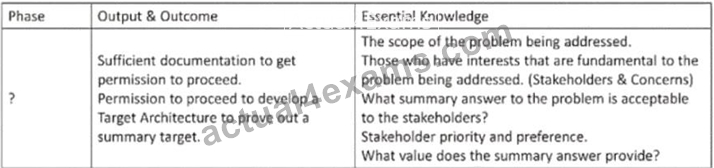
Which ADM Phase does this describe?
- A. Phase C
- B. Phase B
- C. Phase A
- D. Preliminary Phase
Answer: B
Explanation:
Phase B of the ADM cycle is the Business Architecture phase. It describes the development of a Business Architecture to support an agreed Architecture Vision. The objectives of this phase are to describe the baseline and target Business Architecture, identify candidate Architecture Roadmap components based on gaps between the baseline and target, and determine whether an incremental approach is required. Reference:
The TOGAF Standard | The Open Group Website, Section 3.2.2 Phase B: Business Architecture.
NEW QUESTION # 34
What should be put in place through organization structures, roles, responsibilities, skills and processes to carry out architectural activity effectively?
- A. An EA framework
- B. An EA repository
- C. An Enterprise Architecture
- D. An EA Capability
Answer: D
Explanation:
Explanation
An EA Capability is the ability of an organization to perform enterprise architecture effectively and efficiently.
It involves establishing and maintaining the appropriate organization structures, roles, responsibilities, skills, processes, tools, and governance mechanisms to support the development and use of enterprise architecture. An EA Capability enables the organization to align its business and IT strategies, deliver value from its investments, manage change and complexity, and improve its performance and agility12 References: 1: The TOGAF Standard, Version 9.2, Part VI: Architecture Capability Framework, Chapter 44: Introduction 2: The TOGAF Standard, Version 9.2, Part VI: Architecture Capability Framework, Chapter 45: Establishing and Maintaining an Enterprise Architecture Capability
NEW QUESTION # 35
Exhibit: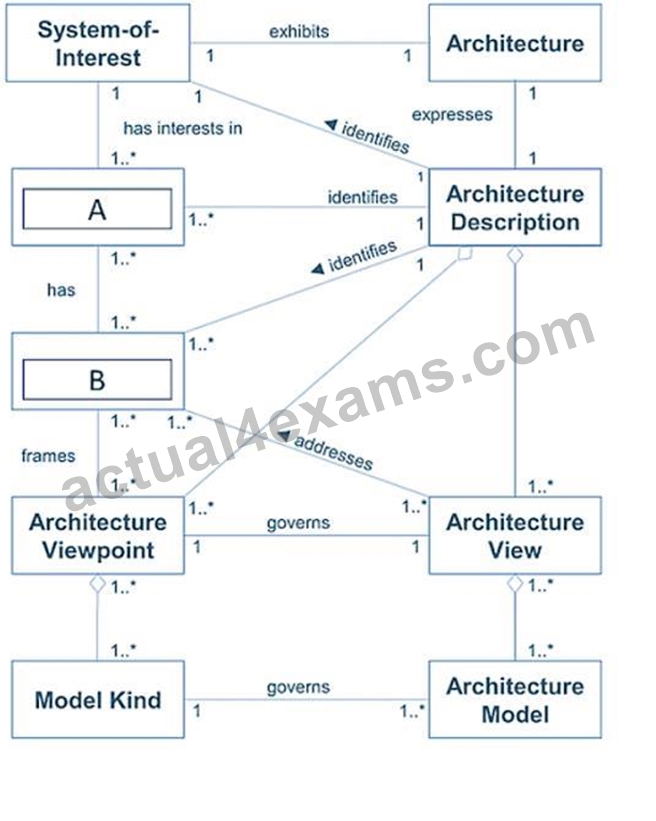
Consider the image showing basic architectural concepts.
What are items A and B?
- A. A-Candidate Architecture, B-Trade-off
- B. A-Stakeholder, B-Concern
- C. A-User, B-Requirement
- D. A-Base Architecture, B-Target Architecture
Answer: B
Explanation:
In the context of TOGAF, a stakeholder is any individual, team, or organization who has interests in, or concerns relative to, the outcome of the architecture. Concerns are those interests which pertain to any aspect of the system's functioning, development or operation, including considerations such as performance, reliability, and security1. References:
*The TOGAF Standard, Version 9.2 - Definitions - The Open Group
NEW QUESTION # 36
Complete the sentence A business scenario describes______________
- A. general rules and guidelines tor the architecture being developed
- B. business and technology environment in which those problems occur
- C. business domain gaps such as cross-training requirements
- D. shortfalls between the Baseline and Target Architectures
Answer: B
NEW QUESTION # 37
Consider the following descriptions of deliverables consumed and produced across the TOGAF ADM cycle.
General rules and guidelines, intended to be enduring and seldom amended, that inform and support the way in which an organization sets about fulfilling its mission
The joint agreements between development partners and sponsors on the deliverables, quality, and fitness-for-purpose of an architecture.
A document that is sent from the sponsoring organization to the architecture organization to trigger the start of an architecture development cycle
A set of quantitative statements that outline what an implementation project must do in order to comply with the architecture.
Which deliverables match these descriptions?
- A. 1 Architecture Principles -2 Architecture Contracts - 3 Architecture Requirements Specification-4 Request for Architecture Work
- B. 1 Architecture Requirements Specification -2 Architecture Principles - 3 Architecture Vision - 4 Architecture Contracts
- C. 1 Architecture Principles -2 Architecture Contracts - 3 Request for Architecture Work - 4 Architecture Requirements Specification
- D. 1 Architecture Contracts - 2 Architecture Requirements Specification - 3 Architecture Vision - 4 Architecture Principles
Answer: A
Explanation:
According to the TOGAF standard, the deliverables that match the descriptions are as follows:
1 Architecture Principles: These are general rules and guidelines, intended to be enduring and seldom amended, that inform and support the way in which an organization sets about fulfilling its mission1. They reflect a level of consensus among the various elements of the enterprise, and form the basis for making future IT decisions1.
2 Architecture Contracts: These are the joint agreements between development partners and sponsors on the deliverables, quality, and fitness-for-purpose of an architecture2. They are used to ensure that the architecture is implemented and governed according to the agreed-upon specifications and standards2.
3 Request for Architecture Work: This is a document that is sent from the sponsoring organization to the architecture organization to trigger the start of an architecture development cycle3. It defines the scope, schedule, budget, deliverables, and stakeholders of the architecture project3.
4 Architecture Requirements Specification: This is a set of quantitative statements that outline what an implementation project must do in order to comply with the architecture4. It defines the requirements for each architecture domain, as well as the relationships and dependencies among them4.
1: Architecture Principles
2: Architecture Contracts
3: Request for Architecture Work
4: Architecture Requirements Specification
NEW QUESTION # 38
Which of the following is included as part of Architecture Governance1?
- A. Managing Stakeholders and their requirements
- B. Ensuring compliance with internal and external standards and regulatory obligations
- C. Creating and maintaining the Statement of Architecture Work though out the ADM cycle
- D. Interacting with the CxO level on Enterprise Architecture
Answer: B
Explanation:
Ensuring compliance with internal and external standards and regulatory obligations is one of the activities included as part of Architecture Governance. Architecture Governance is the practice and orientation by which enterprise architectures and other architectures are managed and controlled at an enterprise-wide level. It involves establishing processes, roles, responsibilities, policies, and standards to ensure that architectures are aligned with the enterprise's strategy and objectives, and meet the quality and performance requirements. Reference: The TOGAF Standard | The Open Group Website, Section 3.3.6 Architecture Governance.
NEW QUESTION # 39
What are the following activities part of?
. Risk classification
. Risk identification
. Initial risk assessment
- A. Phase G
- B. Security Architecture
- C. Phase A
- D. Risk Management
Answer: D
Explanation:
Risk management is a generic technique that can be applied across all phases of the Architecture Development Method (ADM), as well as in the Preliminary Phase and the Requirements Management Phase2.
Risk management involves the following steps1:
*Risk identification: This step involves identifying the potential risks that may affect the architecture project, such as technical, business, organizational, environmental, or legal risks. The risks can be identified through various sources, such as stakeholder interviews, workshops, surveys, checklists, historical data, or expert judgment.
*Risk classification: This step involves categorizing the risks based on their nature, source, impact, and priority. The risks can be classified according to different criteria, such as time, cost, scope, quality, security, or compliance. The classification helps in prioritizing the risks and allocating resources and efforts to address them effectively.
*Initial risk assessment: This step involves assessing the likelihood and impact of each risk, and determining the initial level of risk. The likelihood is the probability of the risk occurring, and the impact is the severity of the consequences if the risk occurs. The initial level of risk is the product of the likelihood and impact, and it indicates the urgency and importance of the risk. The initial risk assessment helps in identifying the most critical risks that need immediate attention and mitigation.
References: 1: The TOGAF Standard, Version 9.2 - Risk Management 2: TOGAF ADM: Top 10 techniques - Part 9: Risk Management
NEW QUESTION # 40
Complete the sentence Business Transformation Readiness Assessment is_________________.
- A. to ensure the active support of powerful stakeholders
- B. a way to put building blocks into context thereby supporting re-usable solutions
- C. a joint effort between corporate staff lines of business and IT planners
- D. widely used to validate an architecture that is being developed
Answer: C
Explanation:
Business Transformation Readiness Assessment is a joint effort between corporate staff lines of business and IT planners to evaluate the readiness of the organization to undergo change. It involves assessing factors such as vision, commitment, capacity, capability, culture, and motivation that may influence the success of a business transformation initiative. Reference: The TOGAF Standard | The Open Group Website, Section
3.3.2 Business Transformation Readiness Assessment.
NEW QUESTION # 41
Complete the sentence The purpose of the Preliminary Phase is to_____________.
- A. define the enterprise strategy
- B. architect an Enterprise Architecture Capability
- C. identify the stakeholders and their requirements
- D. describe the target architecture
Answer: B
Explanation:
Explanation
The purpose of the Preliminary Phase is to architect an Enterprise Architecture Capability that meets the needs and expectations of the enterprise's stakeholders and supports and enables subsequent phases of architecture development and transition. This phase involves defining the scope, principles, framework, and governance for the Enterprise Architecture Capability. Reference: The TOGAF Standard | The Open Group Website, Section 3.2 Preliminary Phase.
NEW QUESTION # 42
......
The OGEA-103 exam is a rigorous and comprehensive test of an individual's knowledge and skills in enterprise architecture. Successfully passing OGEA-103 exam can demonstrate to employers and clients that you are a highly competent and knowledgeable professional in this field, and can help to advance your career in enterprise architecture.
Exam Engine for OGEA-103 Exam Free Demo & 365 Day Updates: https://braindumps.actual4exams.com/OGEA-103-real-braindumps.html