


[Jun 18, 2026] MuleSoft-Integration-Architect-I Exam Brain Dumps - Study Notes and Theory
Pass Salesforce MuleSoft-Integration-Architect-I Test Practice Test Questions Exam Dumps
Salesforce MuleSoft-Integration-Architect-I Exam Syllabus Topics:
| Topic | Details |
|---|---|
| Topic 1 |
|
| Topic 2 |
|
| Topic 3 |
|
| Topic 4 |
|
| Topic 5 |
|
| Topic 6 |
|
| Topic 7 |
|
NEW QUESTION # 163
Which Anypoint Platform component should a MuleSoft developer use to create an API specification prior to building the API implementation?
- A. MUnit
- B. API Designer
- C. API Manager
- D. Runtime Manager
Answer: B
Explanation:
A MuleSoft developer should use API Designer to create an API specification prior to building the API implementation. API Designer is a component of Anypoint Platform that provides a web-based interface for designing and documenting APIs. It supports API modeling languages such as RAML and OAS, enabling developers to define the structure, resources, and operations of an API before proceeding with implementation. This approach aligns with the design-first methodology, ensuring a well-defined contract for the API.
References:
* Anypoint API Designer
* API Design Best Practices
NEW QUESTION # 164
An organization needs to enable access to their customer data from both a mobile app and a web application, which each need access to common fields as well as certain unique fields. The data is available partially in a database and partially in a 3rd-party CRM system. What APIs should be created to best fit these design requirements?
- A. A Process API that contains the data required by both the web and mobile apps, allowing these applications to invoke it directly and access the data they need thereby providing the flexibility to add more fields in the future without needing API changes.
- B. One set of APIs (Experience API, Process API, and System API) for the web app, and another set for the mobile app.
- C. Separate Experience APIs for the mobile and web app, but a common Process API that invokes separate System APIs created for the database and CRM system
- D. A common Experience API used by both the web and mobile apps, but separate Process APIs for the web and mobile apps that interact with the database and the CRM System.
Answer: C
Explanation:
Lets analyze the situation in regards to the different options available Option : A common Experience API but separate Process APIs Analysis : This solution will not work because having common experience layer will not help the purpose as mobile and web applications will have different set of requirements which cannot be fulfilled by single experience layer API Option : Common Process API Analysis : This solution will not work because creating a common process API will impose limitations in terms of flexibility to customize API;s as per the requirements of different applications. It is not a recommended approach.
Option : Separate set of API's for both the applications Analysis : This goes against the principle of Anypoint API-led connectivity approach which promotes creating reusable assets. This solution may work but this is not efficient solution and creates duplicity of code.
Hence the correct answer is: Separate Experience APIs for the mobile and web app, but a common Process API that invokes separate System APIs created for the database and CRM system Lets analyze the situation in regards to the different options available Option : A common Experience API but separate Process APIs Analysis : This solution will not work because having common experience layer will not help the purpose as mobile and web applications will have different set of requirements which cannot be fulfilled by single experience layer API Option : Common Process API Analysis : This solution will not work because creating a common process API will impose limitations in terms of flexibility to customize API;s as per the requirements of different applications. It is not a recommended approach.
Option : Separate set of API's for both the applications Analysis : This goes against the principle of Anypoint API-led connectivity approach which promotes creating reusable assets. This solution may work but this is not efficient solution and creates duplicity of code.
Hence the correct answer is: Separate Experience APIs for the mobile and web app, but a common Process API that invokes separate System APIs created for the database and CRM system
NEW QUESTION # 165
An organization plans to migrate all its Mule applications to Runtime Fabric (RTF). Currently, all Mule applications have been deployed to CloudHub using automated CI/CD scripts.
What steps should be taken to properly migrate the applications from CloudHub to RTF, while keeping the same automated CI/CD deployment strategy?
- A. - The pom.xml and Mule configuration YAML files can remain unchanged in each Mule application.
A --runtimeFabric command-line parameter should be added to the CI/CD deployment scripts - B. runtimeFabric command-line parameter should be added to the CI/CD deployment scripts.
- C. A runtimefabric dependency should be added as a mule-plugin to the pom.xml file in all the Mule applications.
- D. runtimefabricDeployment profile should be added to the pom.xml file in all the Mule applications. CI
/CD scripts must be modified to use the new RTF profile. - E. A runtimefFabricDeployment profile should be added to Mule configuration properties YAML files in all the Mule applications.
CI/CD scripts must be modified to use the new configuration properties.
Answer: D
Explanation:
To migrate Mule applications from CloudHub to Runtime Fabric (RTF) while maintaining the same automated CI/CD deployment strategy, follow these steps:
* Add runtimefabricDeployment Profile: Add a runtimefabricDeployment profile to the pom.xml file in all Mule applications. This profile will include the necessary configurations specific to RTF deployments.
* Modify CI/CD Scripts: Update the CI/CD deployment scripts to use the new runtimefabricDeployment profile. This modification ensures that the deployment process will correctly reference the RTF-specific configurations when deploying applications.
* Keep Configuration Files Unchanged: There is no need to change the pom.xml and Mule configuration YAML files other than adding the runtimefabricDeployment profile. This maintains consistency and reduces the risk of errors during the migration.
This approach ensures a smooth transition to RTF while leveraging existing CI/CD scripts with minimal changes, maintaining the automated deployment strategy.
References
* MuleSoft Documentation on Runtime Fabric Deployment
* Best Practices for CI/CD with MuleSoft
NEW QUESTION # 166
In one of the critical payment related mule application, transaction is being used . As an enhancement to implementation , scatter gather route is introduced which is also the part of transaction group. Scatter gather route has 4 routes.
What will be the behavior of the Mule application in case of error occurs in 4th route of the scatter-gather router and transaction needs to be rolled back?
- A. All routes will be rolled back
- B. Only errored route will be rolled back
- C. Scatter Gather router cannot be part of transaction
Answer: A
Explanation:
*Scatter Gather: When running within a transaction, Scatter Gather does not execute in parallel. This means that the second route is executed after the first one is processed, the third after the second one, etc. In case of error, all routes will be rolled back
NEW QUESTION # 167
An API has been updated in Anypoint Exchange by its API producer from version 3.1.1 to 3.2.0 following accepted semantic versioning practices and the changes have been communicated via the API's public portal. The API endpoint does NOT change in the new version. How should the developer of an API client respond to this change?
- A. The API producer should be requested to run the old version in parallel with the new one.
- B. The API producer should be contacted to understand the change to existing functionality.
- C. The API client code ONLY needs to be changed if it needs to take advantage of new features.
- D. The update should be identified as a project risk and full regression testing of the functionality that uses this API should be run.
Answer: C
Explanation:
* Semantic Versioning is a 3-component number in the format of X.Y.Z, where :
X stands for a major version.
Y stands for a minor version:
Z stands for a patch.
So, SemVer is of the form Major.Minor.Patch Coming to our question , minor version of the API has been changed which is backward compatible. Hence there is no change required on API client end. If they want to make use of new featured that have been added as a part of minor version change they may need to change code at their end. Hence correct answer is The API client code ONLY needs to be changed if it needs to take advantage of new features.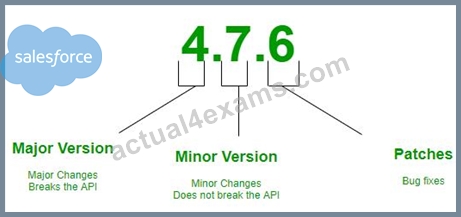
NEW QUESTION # 168
An organization's IT team follows an API-led connectivity approach and must use Anypoint Platform to implement a System AP\ that securely accesses customer data. The organization uses Salesforce as the system of record for all customer data, and its most important objective is to reduce the overall development time to release the System API.
The team's integration architect has identified four different approaches to access the customer data from within the implementation of the System API by using different Anypoint Connectors that all meet the technical requirements of the project.
- A. Use the Anypoint Connector for Database to connect to a MySQL database to access a copy of the customer data
- B. Use the Anypoint Connector tor FTP to download a file containing a recent near-real time extract of the customer data
- C. Use the Anypoint Connector for Salesforce to connect to the Salesforce APIs to directly access the customer data
- D. Use the Anypoint Connector for HTTP to connect to the Salesforce APIs to directly access the customer data
Answer: C
Explanation:
To reduce the overall development time to release the System API, the most efficient approach is to use the Anypoint Connector for Salesforce. This connector is specifically designed to interact with Salesforce APIs, providing a seamless and optimized way to access customer data directly from Salesforce. Using this connector simplifies development, reduces complexity, and leverages built-in capabilities for authentication and data retrieval, ensuring a faster and more secure implementation.
References:
* Anypoint Connector for Salesforce
* Connecting to Salesforce with Anypoint Platform
NEW QUESTION # 169
What best describes the Fully Qualified Domain Names (FQDNs), also known as DNS entries, created when a Mule application is deployed to the CloudHub Shared Worker Cloud?
- A. The FQDNs are determined by the application name, but can be modified by an administrator after deployment
- B. A fixed number of FQDNs are created, IRRESPECTIVE of the environment and VPC design
- C. The FQDNs are determined by the application name chosen, IRRESPECTIVE of the region
- D. The FQDNs are determined by both the application name and the region
Answer: D
Explanation:
Every Mule application deployed to CloudHub receives a DNS entry pointing to the CloudHub. The DNS entry is a CNAME for the CloudHub Shared Load Balancer in the region to which the Mule application is deployed. When we deploy the application on CloudHub, we get a generic url to access the endpoints. Generic URL looks as below:
<application-name>.<region>.cloudhub.io <application-name> is the deployed application name which is unique across all the MuleSoft clients. <region> is the region name in which an application is deployed.
The public CloudHub (shared) load balancer already redirects these requests, where myApp is the name of the Mule application deployment to CloudHub: HTTP requests to http://myApp.<region>.cloudhub.io redirects to
http://mule-worker-myApp.<region>.cloudhub.io:8081
HTTPS traffic to https://myApp.<region>.cloudhub.io redirects to
https://mule-worker-myApp.<region>.cloudhub.io:8082
NEW QUESTION # 170
What is true about automating interactions with Anypoint Platform using tools such as Anypoint Platform REST API's, Anypoint CLI or the Mule Maven plugin?
- A. Anypoint Platform API's can only automate interactions with CloudHub while the Mule maven plugin is required for deployment to customer hosted Mule runtimes
- B. Access to Anypoint Platform API;s and Anypoint CLI can be controlled separately thruough the roles and permissions in Anypoint platform, so that specific users can get access to Anypoint CLI while others get access to the platform API's
- C. By default, the Anypoint CLI and Mule Maven plugin are not included in the Mule runtime
- D. API policies can be applied to the Anypoint platform API's so that only certain LOS's has access to specific functions
Answer: C
Explanation:
Correct answer is By default, the Anypoint CLI and Mule Maven plugin are not included in the Mule runtime Maven is not part of runtime though it is part of studio. You do not need it to deploy in order to deploy your app. Same is the case with CLI.
NEW QUESTION # 171
Which of the below requirements prevent the usage of Anypoint MQ in a company's network? (Choose two answers)
- A. ability for a third party outside the company's network to consume events from the queue
- B. payloads must be encrypted
- C. support for point-to-point messaging
- D. the message broker must be hosted on premises
- E. single message payload can be up to 15 MB
Answer: A,D
Explanation:
Anypoint MQ is a cloud-based messaging service provided by MuleSoft. It is designed to work within MuleSoft's cloud ecosystem, which can impose certain limitations that might prevent its use in some scenarios:
* Message Broker Must Be Hosted On-Premises:
* Anypoint MQ is a cloud service and cannot be hosted on-premises. If a company requires its message broker to be hosted within its own data center for security, compliance, or other reasons, Anypoint MQ would not be suitable.
* Ability for a Third Party Outside the Company's Network to Consume Events from the Queue:
* Anypoint MQ is designed to work primarily within the Anypoint Platform ecosystem. While it does support external consumers, it requires proper security configurations, and there may be limitations or additional steps needed to securely expose queues to third-party systems outside the company's network.
References
* MuleSoft Documentation: Anypoint MQ
* MuleSoft Anypoint MQ Overview
NEW QUESTION # 172
A mule application designed to fulfil two requirements
a) Processing files are synchronously from an FTPS server to a back-end database using VM intermediary queues for load balancing VM events b) Processing a medium rate of records from a source to a target system using batch job scope Considering the processing reliability requirements for FTPS files, how should VM queues be configured for processing files as well as for the batch job scope if the application is deployed to Cloudhub workers?
- A. Use VM connector persistent queues for FTPS file processing Disable VM queue for the batch job scope
- B. Use Cloud hub persistent queues for FTPS files processing
There is no need to configure VM queues for the batch jobs scope as it uses by default the worker's disc for VM queueing - C. Use Cloud hub persistent VM queue for FTPS file processing
There is no need to configure VM queues for the batch jobs scope as it uses by default the worker's JVM memory for VM queueing - D. Use Cloud hub persistent VM queues for FTPS file processing
Disable VM queue for the batch job scope
Answer: D
NEW QUESTION # 173
Refer to the exhibit.
A business process involves the receipt of a file from an external vendor over SFTP. The file needs to be parsed and its content processed, validated, and ultimately persisted to a database. The delivery mechanism is expected to change in the future as more vendors send similar files using other mechanisms such as file transfer or HTTP POST.
What is the most effective way to design for these requirements in order to minimize the impact of future change?
- A. Use a MuleSoft Scatter-Gather and a MuleSoft Batch Job to handle the different files coming from different sources
- B. Create an API that receives the file and invokes a Process API with the data contained In the file, then have the Process API process the data using a MuleSoft Batch Job and other System APIs as needed
- C. Use a composite data source so files can be retrieved from various sources and delivered to a MuleSoft Batch Job for processing
- D. Create a Process API to receive the file and process it using a MuleSoft Batch Job while delegating the data save process to a System API
Answer: B
Explanation:
* Scatter-Gather is used for parallel processing, to improve performance. In this scenario, input files are coming from different vendors so mostly at different times. Goal here is to minimize the impact of future change. So scatter Gather is not the correct choice.
* If we use 1 API to receive all files from different Vendors, any new vendor addition will need changes to that 1 API to accommodate new requirements. So Option A and C are also ruled out.
* Correct answer is Create an API that receives the file and invokes a Process API with the data contained in the file, then have the Process API process the data using a MuleSoft Batch Job and other System APIs as needed. Answer to this question lies in the API led connectivity approach.
* API-led connectivity is a methodical way to connect data to applications through a series of reusable and purposeful modern APIs that are each developed to play a specific role - unlock data from systems, compose data into processes, or deliver an experience. System API : System API tier, which provides consistent, managed, and secure access to backend systems. Process APIs : Process APIs take core assets and combines them with some business logic to create a higher level of value. Experience APIs : These are designed specifically for consumption by a specific end-user app or device.
So in case of any future plans , organization can only add experience API on addition of new Vendors, which reuse the already existing process API. It will keep impact minimal.
Diagram Description automatically generated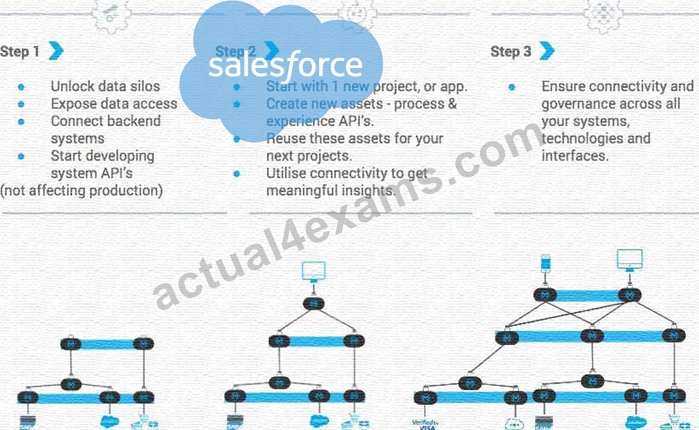
NEW QUESTION # 174
A corporation has deployed Mule applications to different customer-hosted Mule runtimes. Mule applications deployed to these Mule runtimes are managed by Anypoint Platform.
What needs to be installed or configured (if anything) to monitor these Mule applications from Anypoint Monitoring, and how is monitoring data from each Mule application sent to Anypoint Monitoring?
- A. Install an Anypoint Monitoring agent on each Mule runtime.
Each Anypoint Monitoring agent sends monitoring data from the Mule applications running in its Mule runtime to Anypoint Monitoring. - B. Install a Runtime Manager agent on each Mule runtime.
Each Runtime Manager agent sends monitoring data from the Mule applications running in its Mule runtime to Runtime Manager, then Runtime Manager sends monitoring data to Anypoint Monitoring. - C. Enable monitoring of individual Mule applications from the Runtime Manager application settings.
Runtime Manager sends monitoring data to Anypoint Monitoring for each deployed Mule application. - D. Leave the out-of-the-box Anypoint Monitoring agent unchanged in its default Mule runtime installation.
Each Anypoint Monitoring agent sends monitoring data from the Mule applications running in its Mule runtime to Runtime Manager, then Runtime Manager sends monitoring data to Anypoint Monitoring.
Answer: C
NEW QUESTION # 175
A system API EmployeeSAPI is used to fetch employee's data from an underlying SQL database.
The architect must design a caching strategy to query the database only when there is an update to the employees stable or else return a cached response in order to minimize the number of redundant transactions being handled by the database.
What must the architect do to achieve the caching objective?
- A. Use a Scheduler with a fixed frequency every hour triggering an invalidate cache flow Use an object store caching strategy and set expiration interval to 1-hour
- B. Use a Scheduler with a fixed frequency every hour triggering an invalidate cache flow Use an object store caching strategy and expiration interval to empty
- C. Use an On Table Row on employees table and call invalidate cache
Use an object store caching strategy and expiration interval to empty - D. Use an on table rule on employees table call invalidate cache and said new employees data to cache Use an object store caching strategy and set expiration interval to 1-hour
Answer: C
Explanation:
To achieve efficient caching and reduce redundant database transactions, the following strategy can be implemented:
* On Table Row Listener: Implement an "On Table Row" trigger on the employees' table. This trigger will monitor changes (inserts, updates, deletes) in the employee records.
* Invalidate Cache: Upon detecting changes in the employees' table, the trigger will call a flow to invalidate the current cache.
* Object Store for Caching: Utilize MuleSoft's object store to cache the employee data. This store can hold the data for quick retrieval.
* Set Expiration Interval: Configure the expiration interval for the cached data to ensure it is cleared when necessary. For this scenario, since we are invalidating cache on actual data changes, setting the expiration interval to empty can be suitable.
* Return Cached Data: If there are no updates, the cached response is returned, reducing database load.
References:
* MuleSoft Documentation on Object Store
* Caching Strategies
NEW QUESTION # 176
According to MuleSoft, a synchronous invocation of a RESTful API using HTTP to get an individual customer record from a single system is an example of which system integration interaction pattern?
- A. One-way
- B. Request-Reply
- C. Batch
- D. Multicast
Answer: B
NEW QUESTION # 177
An auto mobile company want to share inventory updates with dealers Dl and D2 asynchronously and concurrently via queues Q1 and Q2. Dealer Dl must consume the message from the queue Q1 and dealer D2 to must consume a message from the queue Q2.
Dealer D1 has implemented a retry mechanism to reprocess the transaction in case of any errors while processing the inventers updates. Dealer D2 has not implemented any retry mechanism.
How should the dealers acknowledge the message to avoid message loss and minimize impact on the current implementation?
- A. Dealer D1 and dealer D2 must use AUTO acknowledgement and acknowledge the message after successful processing
- B. Dealer D1 can use AUTO acknowledgement and dealer D2 must use manual acknowledgement and acknowledge the message
- C. Dealer D1 must use auto acknowledgement and dealer D2 can use manual acknowledgement and acknowledge the message after successful processing
- D. Dealer D1 can use auto acknowledgement and dealer D2 can use IMMEDIATE acknowledgement and acknowledge the message of successful processing
Answer: B
Explanation:
after successful processing
NEW QUESTION # 178
......
Verified MuleSoft-Integration-Architect-I dumps Q&As - MuleSoft-Integration-Architect-I dumps with Correct Answers: https://braindumps.actual4exams.com/MuleSoft-Integration-Architect-I-real-braindumps.html