


[Dec-2025] Updated SAP C_THR81_2505 Dumps – PDF & Online Engine
C_THR81_2505.pdf - Questions Answers PDF Sample Questions Reliable
SAP C_THR81_2505 Exam Syllabus Topics:
| Topic | Details |
|---|---|
| Topic 1 |
|
| Topic 2 |
|
| Topic 3 |
|
| Topic 4 |
|
NEW QUESTION # 32
What base object must you use for the Jobinfo_FTF_Comp rule?
- A. Non Recurring Pay Component Model
- B. Job Information Model
- C. Compensation Model
- D. Compensation Information Model
Answer: B
Explanation:
The Job Information Model is the base object used for the Jobinfo_FTF_Comp rule.
This rule applies to job information-related events and ensures that the necessary validations or transformations are triggered based on job data changes.
As Job Information is the foundational data structure for tracking employee roles, positions, and assignments, it is the correct base object for this scenario.
Scenario 1: HR Transaction Rules
NEW QUESTION # 33
When the manager updates the location of an employee, the HR admin must be the approver Note that the HR admin, manager, and HR Business Partner have access to change the location.
How do you create the IF condition for the workflow derivation rule lo meet the above requirements?
- A. Option C
- B. Option D
- C. Option B
- D. Option A
Answer: D
Explanation:
To meet the requirement where the HR admin must approve the manager's updates to an employee's location, the workflow derivation rule must include the following IF condition:
Option A: Ensures that the condition checks whether the user belongs to the permission group for HR Admins, and the Event Reason value matches "Location Change".
This configuration aligns the workflow rule with the scenario requirements, where HR admins are explicitly designated as approvers Scenario 2: Approvals for Self-Service
NEW QUESTION # 34
Where do you enable the Enter Manager to Filter Positions option to only display manager's lower-level positions in Hire, MSS Job Information and History?
- A. In Settings > Hierarchy Adaptation
- B. In Settings > Ul Customizing
- C. In Manage Business Configuration > jobinfo
- D. In Configure Object Definitions > Position
Answer: B
NEW QUESTION # 35
An employee will be changing their nationality information on their own How do you build the IF condition in the business rule so they can do this?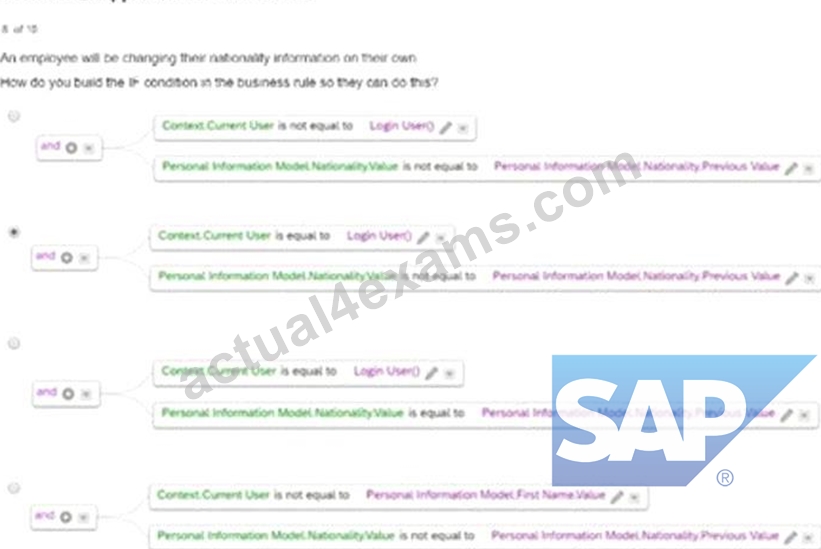
- A. Option B
- B. Option C
- C. Option A
- D. Option D
Answer: A
Explanation:
In order for an employee to change their nationality information on their own, the IF condition must:
* Validate that the Context.Current User is equal to Login User (ensures that the logged-in user is making the changes).
* Check if the Nationality.Value is not equal to the Nationality.Previous Value (ensures that a change is being made).
Scenario 2: Approvals for Self-Service
NEW QUESTION # 36
The manager has the ability to change the salary during the workflow
Which of the following options do you need to select for a new workflow to be triggered when the manager edits the salary?
- A. No edit
- B. Edit with Route Change
- C. Edit without Route Change
- D. Edit Attachment Only
Answer: B
Explanation:
To trigger a new workflow when the manager edits the salary during the approval process, you must select Edit with Route Change. This option ensures that when an edit is made, the workflow is restarted or rerouted based on the updated information, allowing for revalidation and approvals to reflect the changes.
This option is essential for ensuring data integrity and compliance during workflows involving edits.
NEW QUESTION # 37
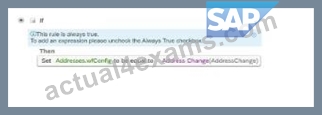
Which clause meets the WFD_Address rule requirement?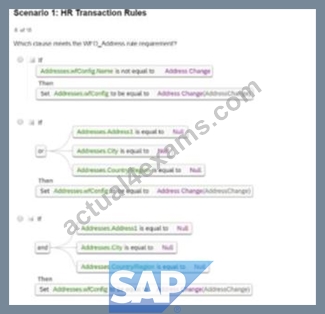
- A. Option C
- B. Option A
- C. Option B
- D. Option D
Answer: D
Explanation:
The clause in Option D meets the WFD_Address rule requirement because it checks the following conditions comprehensively:
Address is not equal to Null.
City and CountryRegion are equal to Null.
When these conditions are met, it sets the configuration for Address Change accordingly, ensuring data completeness and accuracy for address-related transactions.
Scenario 1: HR Transaction Rules
NEW QUESTION # 38
The HR admin has to change the salary of an employee, which will trigger a workflow for the employee's manager. The employee's manager should be able to edit the transaction if the proposed amount is NOT correct.
Where in the workflow do you need to define this?
Refer to the screenshot to answer the question
- A. No Approver Behavior
- B. Respect Permission
- C. Context
- D. Edit Transaction
Answer: D
Explanation:
To allow the employee's manager to edit a transaction in a workflow if the proposed salary change is incorrect, you must configure the "Edit Transaction" setting in the workflow.
The "Edit Transaction" option is part of the workflow configuration in Step 1 (as shown in the screenshot).
When enabled, it allows the approver (in this case, the manager) to make adjustments to the transaction before approving it.
Scenario 2: Approvals for Self-Service
NEW QUESTION # 39
What are some SAP recommended guiding principles to achieve clean core operations? Note: There are 3 correct answers to this question.
- A. Establish an organizational structure, technical foundation, and transformation methodology for clean core.
- B. Establish regular housekeeping tasks and procedures.
- C. Integrate clean core practices in the end-to-end value process chain.
- D. Define roles and responsibilities as part of a process transformation office.
- E. Establish release management.
Answer: A,C,D
Explanation:
SAP recommends the following guiding principles to maintain clean core operations:
Integrate Clean Core Practices in End-to-End Processes: Embed clean core strategies throughout the value chain for consistency.
Define Roles and Responsibilities: Establish clear accountability for clean core implementation via a process transformation office.
Organizational and Technical Foundation: Develop a robust framework, including technical structures and methodologies, to drive clean core adherence.
Other activities like release management and regular housekeeping are operational best practices but not core guiding principles.
Scenario 1: HR Transaction Rules
NEW QUESTION # 40
What association must you use when configuring a relationship between an MDF-based object and a Foundation Object wrapper?
- A. Composite
- B. Valid-When
- C. Join By Column
- D. One-to-one
Answer: A
NEW QUESTION # 41
How should you build the IF condition to identity the user when the employee is updating their own Personal Information?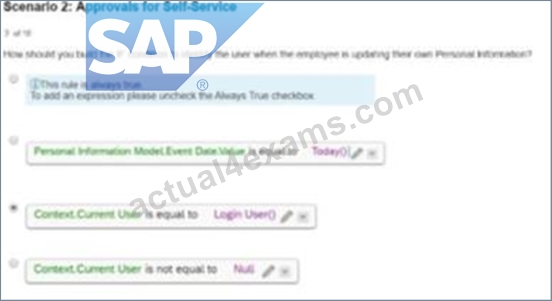
- A. Option A
- B. Option D
- C. Option C
- D. Option B
Answer: C
Explanation:
To identify the user when the employee is updating their own personal information, the IF condition in Option C is correct. This configuration:
Checks if the Context.Current User is equal to the Login User.
Ensures that the rule applies only when the employee is making changes to their own personal data.
This approach is aligned with SAP SuccessFactors logic for self-service scenarios, enabling accurate identification of the user in such workflows.
Scenario 2: Approvals for Self-Service
NEW QUESTION # 42
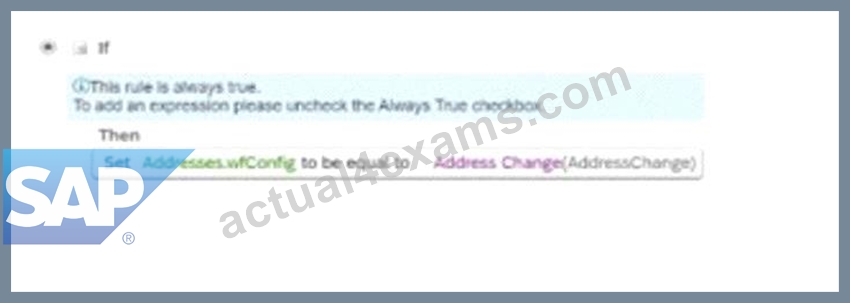
Which clause meets the WFD_Address rule requirement?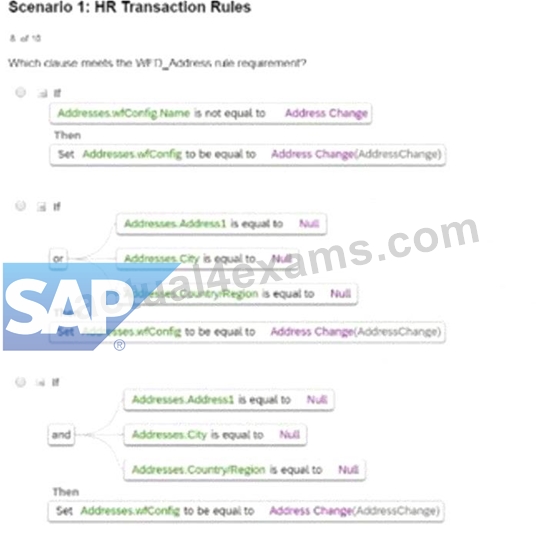
- A. Option C
- B. Option A
- C. Option B
- D. Option D
Answer: D
Explanation:
The clause in Option D meets the WFD_Address rule requirement because it checks the following conditions comprehensively:
* Address is not equal to Null.
* City and CountryRegion are equal to Null.
* When these conditions are met, it sets the configuration for Address Change accordingly, ensuring data completeness and accuracy for address-related transactions.
Scenario 1: HR Transaction Rules
NEW QUESTION # 43
A business rule triggers a transfer event reason when an employee's location is changed. Which base object would you use for this business rule?
- A. Job Information
- B. Employee Information Model
- C. Employee Information
- D. Job Information Model
Answer: D
Explanation:
When creating a business rule to trigger a transfer event reason upon a location change, the Job Information Model is the correct base object. This is because location is a field within the Job Information entity, and changes to fields within this entity are best handled using the Job Information Model base object for related rules.
C: Job Information Model
NEW QUESTION # 44
How do you set the event date in Compensation Information for the jobinfo_FTE_Comp cross-entity rule?
- A. Option C
- B. Option A
- C. Option B
- D. Option D
Answer: D
Explanation:
To set the event date in Compensation Information for the Jobinfo_FTE_Comp cross-entity rule, Option D is the correct method. The approach ensures that the Event Date field in the Compensation Information section aligns with the Event Date in Job Information. This synchronization is crucial for maintaining consistency in effective dates across entities during HR transactions.
Scenario 1: HR Transaction Rules
NEW QUESTION # 45
Which employment objects support a country-specific field configuration? Note: There are 2 correct answers to this question.
- A. Job Information
- B. Pay Component Recurring
- C. Job Relationship Info
- D. Employment Details
Answer: A,D
Explanation:
Country-specific field configurations can be applied to certain employment-related objects in SAP SuccessFactors. These objects include:
Employment Details: This object supports country-specific fields to reflect variations in employment attributes across different countries.
Job Information: This object is frequently used for managing job-related data that varies by country, such as legal entity, location, and pay grade.
Correct Answers:
C: Employment Details
D: Job Information
NEW QUESTION # 46
Which of the following API types does SAP recommend to use to achieve clean core integrations? Note: There are 2 correct answers to this question.
- A. Data
- B. IDoc
- C. RFC
- D. SOAP
Answer: A,D
Explanation:
SAP recommends using SOAP APIs and Data APIs for clean core integrations.
SOAP APIs: Provide a structured, standardized method of communication for integrations, especially suitable for real-time and synchronous processes.
Data APIs: Enable smooth data exchange and are preferred for achieving non-intrusive clean core integrations.
Other methods like IDoc and RFC are older technologies that might compromise the clean core principles by requiring deeper system customizations.
NEW QUESTION # 47
In which entities is Alert Notification supported? Note: There are 2 correct answers to this question.
- A. Address Information
- B. Job Information
- C. Personal Information
- D. Pay Component Recurring
Answer: B,D
Explanation:
Alert Notifications in SAP SuccessFactors Employee Central are supported in the following entities:
Job Information: Alerts can be configured to notify relevant parties about changes or updates in an employee's job information, such as position changes, promotions, or transfers.
Pay Component Recurring: Alerts can be set up to inform stakeholders about modifications in recurring pay components, including salary adjustments, bonuses, or other regular compensation elements.
These notifications facilitate proactive management of employee data changes, ensuring that appropriate actions are taken promptly.
NEW QUESTION # 48
......
SAP C_THR81_2505 Dumps PDF Are going to be The Best Score: https://braindumps.actual4exams.com/C_THR81_2505-real-braindumps.html